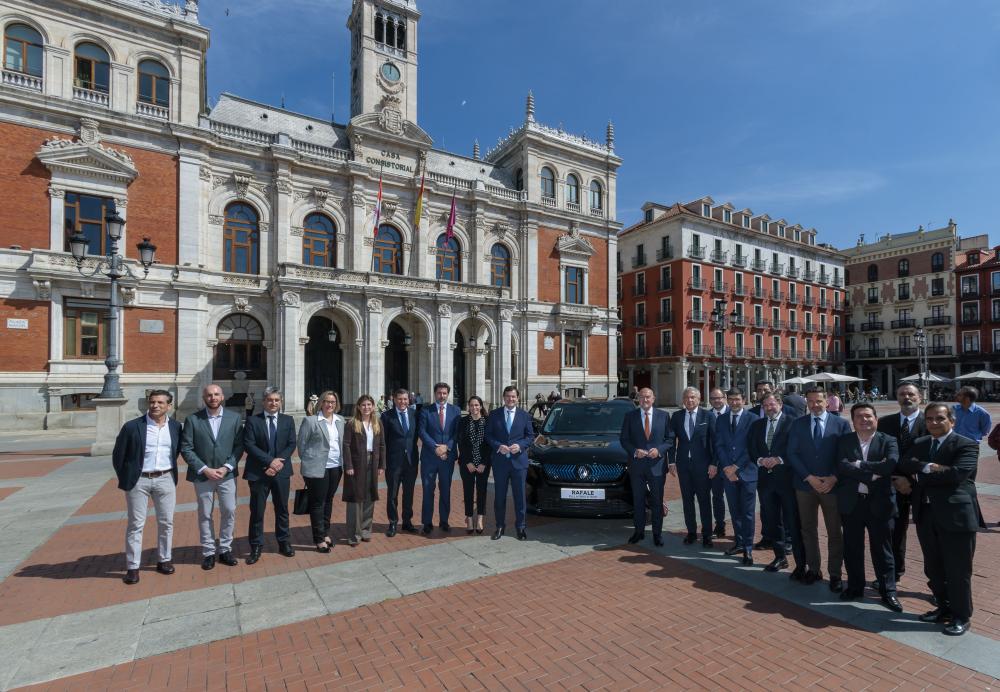
The President of the Regional Government of Castilla y León, Alfonso Fernández Mañueco, took part today in the presentation of the first Urban Connected and Cybersecure Mobility Circuit that will be hosted in Valladolid, a pioneering project in Europe.
In this way, Valladolid will become the first Spanish city to turn into an open-air laboratory in cybersecurity, thanks to this project promoted by the Regional Government of Castilla y León, through the Institute for Business Competitiveness of Castilla y León (ICECYL), with an investment of €3.5 million for its development, co-financed at 75% with Next Generation Funds through the National Cybersecurity Institute (INCIBE).
The project is also being developed through a cooperation agreement signed between the Valladolid City Council and the Regional Government in November 2024, under which the city establishes the use of a map of public roads and urban resources to enable the development of an open-air cybersecurity laboratory that will drive smart mobility in a real urban environment.
The technological project will be led by the R&D teams of Renault Group’s centre in Valladolid, under a joint venture formed by Renault Group (70%) and Orange (30%), in collaboration with Atos, Thales, GMV and AIR Institute, for the development of the Connected and Cybersecure Urban Circuit. This will enable the development of new mobility solutions to improve road safety and urban traffic flow, benefiting citizens and positioning Valladolid as a benchmark in connected and safe mobility.
During his speech at the event, the President of the Regional Government highlighted that this project reflects Castilla y León’s potential to lead innovative initiatives and actively contribute to the transformation of the automotive sector, consolidating Valladolid and the wider region as a benchmark for intelligent, connected and safe mobility at both national and international level.
He also noted that this initiative is part of the Regional Government’s commitment to promoting smart mobility in a region closely linked to the automotive industry, where manufacturers and suppliers will be able to test autonomous and connected vehicle development under real conditions, coexisting with regular traffic and with full safety guarantees.
Furthermore, it is an example of the success of public-private collaboration as a key tool to enable useful and innovative projects in the service of people.
Fernández Mañueco stressed that, in an international context marked by uncertainty and competitiveness challenges, Castilla y León’s automotive sector faces a promising future thanks to its competitive strength and the commitment of the business ecosystem established in the region. In this context, he reaffirmed the Regional Government’s commitment to companies and workers linked to this activity, as well as to technological innovation applied to the sector.
A pioneering initiative in Europe
This project, the first of its kind in Europe, is included in the RETECH-Cybersecurity programme co-financed 25% by the Regional Government of Castilla y León and 75% by European Next Generation funds through INCIBE. Its goal is to deploy an open-air connected urban circuit in Valladolid, integrating state-of-the-art technologies to ensure the security of V2X (Vehicle-to-Everything) connectivity.
This space is designed as a real-world validation environment for manufacturers, automotive suppliers, and the wider smart mobility ecosystem, positioning Castilla y León—and specifically Valladolid—as an international benchmark in connected and secure mobility.
The circuit will be available both for vehicles equipped with V2X technology, which will receive in-vehicle alerts about risk situations (such as pedestrians in blind spots, dangerous crossings, roadworks, etc.), and for non-equipped vehicles, which will be detected in real time through cameras.
The project aims to design, develop and implement a Centre of Excellence in Cybersecurity applied to Connected Mobility in Castilla y León, demonstrating the administration’s commitment to technological advancement and investment in R&D&I.
Project development and impact in Valladolid
The project follows a defined schedule with phases including design, development, implementation and validation of the Centre of Excellence, to be completed before 30 June 2026. Afterwards, the circuit will be deployed in a real urban environment and will enter an initial two-year operation and maintenance phase. After that period, it will be transferred to the Valladolid City Council, ensuring the project’s long-term continuity and the identification of new opportunities.
During its development, visible changes will take place along a route including Avenida de Salamanca, Paseo Isabel la Católica, Paseo de Zorrilla, Avenida de Madrid and Avenida de Zamora. Along this route, 15 V2X communication units (roadside units) will be installed, mainly on traffic control camera poles, of which 12 have already been deployed, along with a speed information display panel and 4 cameras for speed control, parking information and pedestrian protection.
In parallel, use cases will be developed to improve road safety and traffic fluidity, benefiting citizens while positioning Valladolid as a European benchmark in connected mobility.
New Control Centre
The control centre, located in municipal facilities, will operate as an operations hub managing all urban infrastructure and connected electric vehicles (VEC). It will employ cutting-edge technologies in mobile communications, distributed processing, urban sensing and service architecture to enable a cooperative validation environment for connected mobility.
It will include 5G network connectivity with dedicated coverage in the urban area; an Edge Computing (MEC) infrastructure with urban MEC nodes capable of processing V2X events in real time; Cooperative Intelligent Transport Systems enabling real-time information exchange between vehicles, road infrastructure, pedestrians and networks to improve safety, traffic efficiency and reduce environmental impact; and a data and services platform aligned with European standards, integrating municipal systems through data adapters and IoT gateways.